Scoping an AI Concierge from App to WhatsApp
Turning points people had written off into booked trips, through an AI concierge we moved out of an app and into WhatsApp.
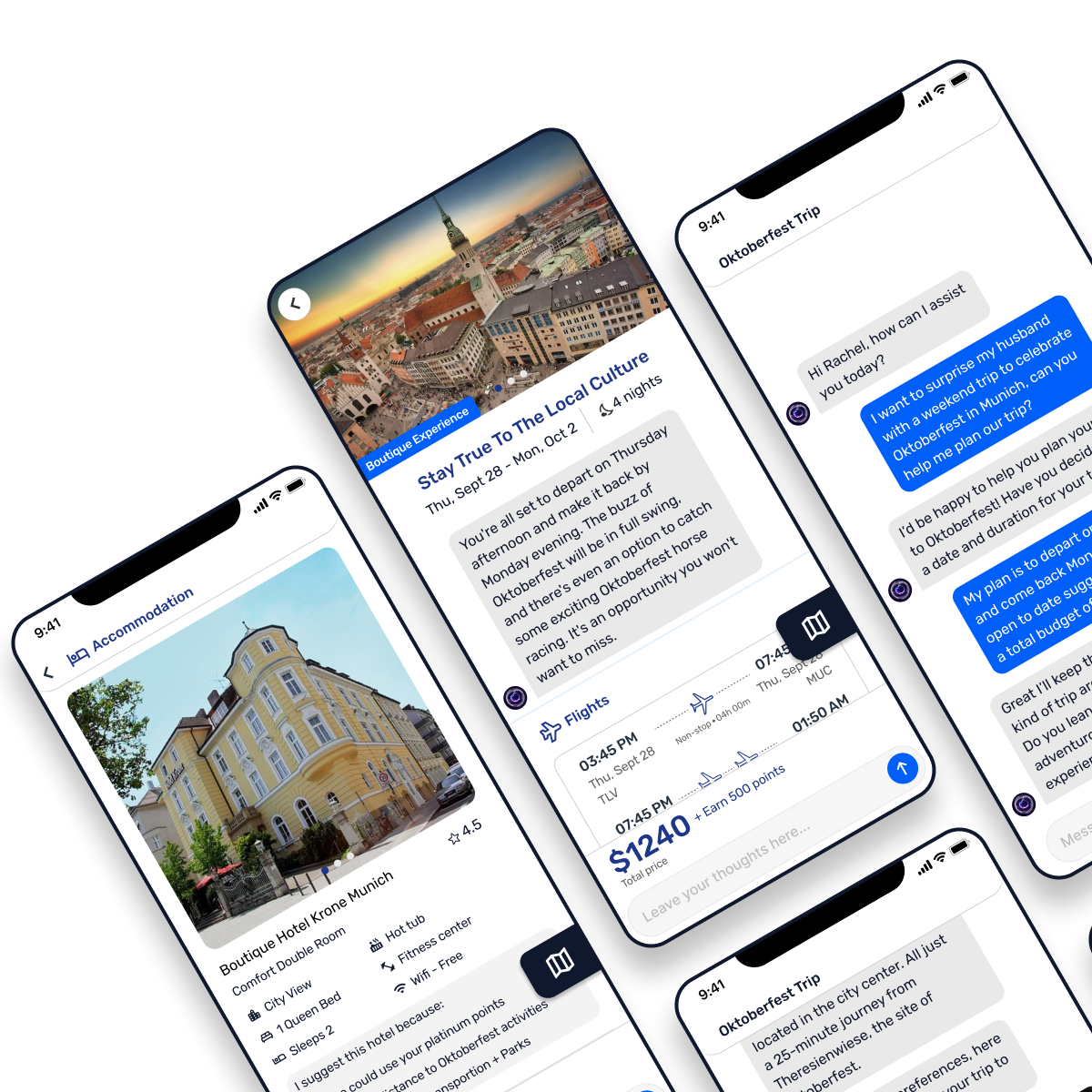
Impact
About the project
Via.ai is a travel-tech startup that turns trip planning into smart usage of loyalty points. Its AI solution gives banks and travel retailers an AI concierge that recommends curated travel services based on existing customer relationships and opening new revenue.
I joined as the sole designer and product strategy advisor, working directly with the two founders and one engineer. That meant I wasn't handed a spec. I helped decide what the product was: which market to enter first, what the AI should and shouldn't do, what we built to prove the idea, and eventually what we threw away to ship it.
The user
Our primary users had loyalty points scattered across companies. Credit cards, hotels, airlines… and no easy way to see what those points were actually worth. Getting the best value meant jumping between sites, comparing redemption rates, and piecing together a trip by hand. Most people gave up and let the points sit.
Our first scoping decision was who to ignore. Rather than build for travelers everywhere, we picked Israel as the beachhead market: high outbound travel, strong loyalty-program adoption, and daily habits already suited to a conversational product. Narrow enough to actually win, and a decision that paid off later in a way we didn't expect.
"What can I get the most out of these points? I don't want to go back and forth between all these sites to find the best deal."
The market backed the bet:
7M+
Outbound trips from Israel in 2022
$40B
Projected travel market size by 2027
$966M
Projected loyalty market size by 2027
The opportunity was clear: pull every program into one trusted conversation, surface the highest-value redemption automatically, and make the whole thing reinforce the retailer's brand.
Meet Daniel
The core challenge wasn't screens. It was deciding what the AI actually was. A search box with better manners, or someone you come back to.
We named it Daniel. That naming wasn't decoration. Giving the agent a name forced us to answer product questions we'd otherwise have left vague: what Daniel knows about you, what he's allowed to recommend, when he pushes and when he backs off. It also gave our partners something to picture, which mattered more in a pitch meeting than any screen did.
I scoped the conversation around three questions the team had to answer before anything could be built:
- How does Daniel respond to vague or evolving requests?
- How does he handle mid-journey changes, like a canceled flight or a sold-out hotel?
- What relationship should someone build with him over time?
Answering those three set the boundaries of v1 and, just as usefully, told us what to leave out.
Plan A: the full mobile app
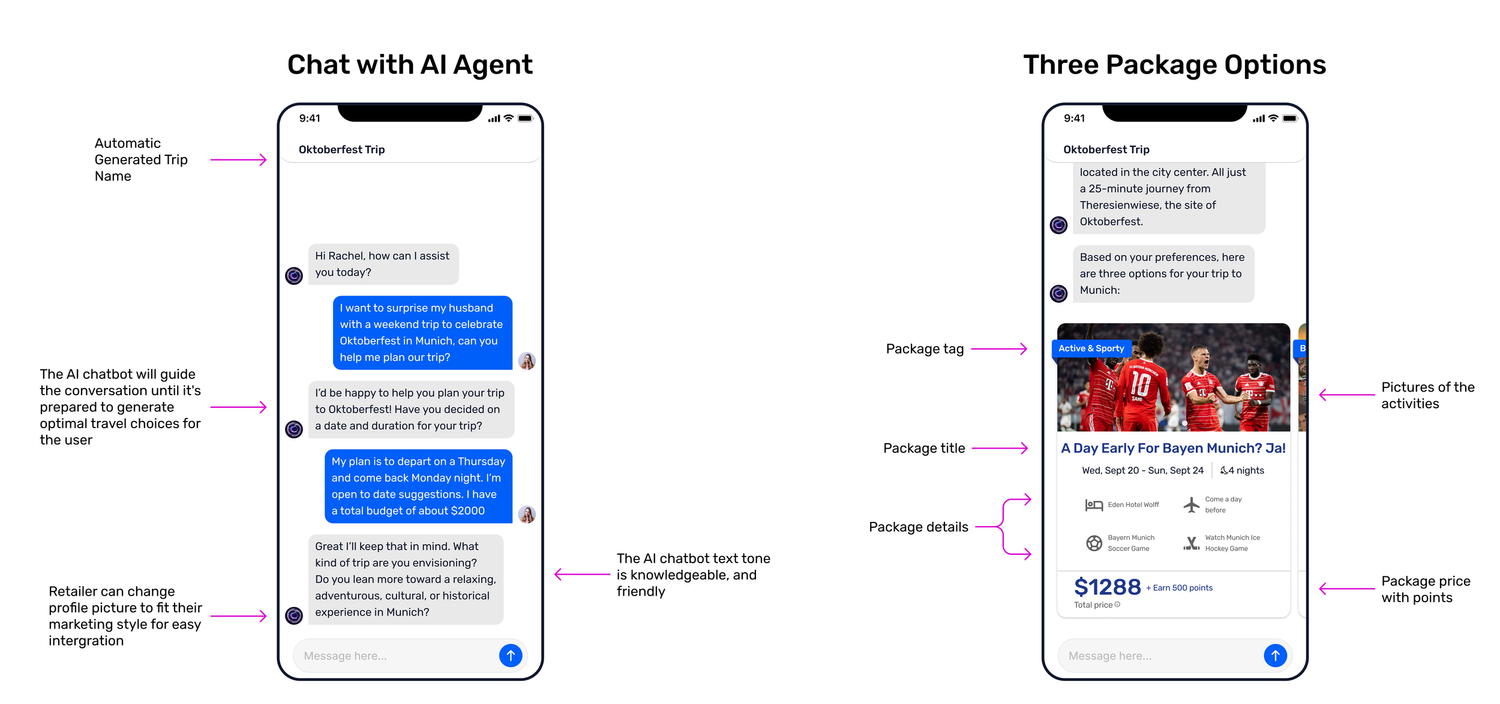
A pre-seed startup has one scarce resource, and it isn't engineering time. It's belief. We bet that the fastest way to buy belief was to make the whole vision feel real before a line of it existed, so I designed a fully interactive, end-to-end app in Figma:
- Personalized trip flows
- Smart destination suggestions
- Retail-point redemption
- Dynamic offers and upgrades
The bet paid. The prototype became the centerpiece of investor and partner conversations, showing concretely how Via.ai could unlock new revenue and deepen loyalty. It helped secure funding and opened doors at major banks, travel retailers, and a national airline.
Then it worked too well.
The call: killing the app
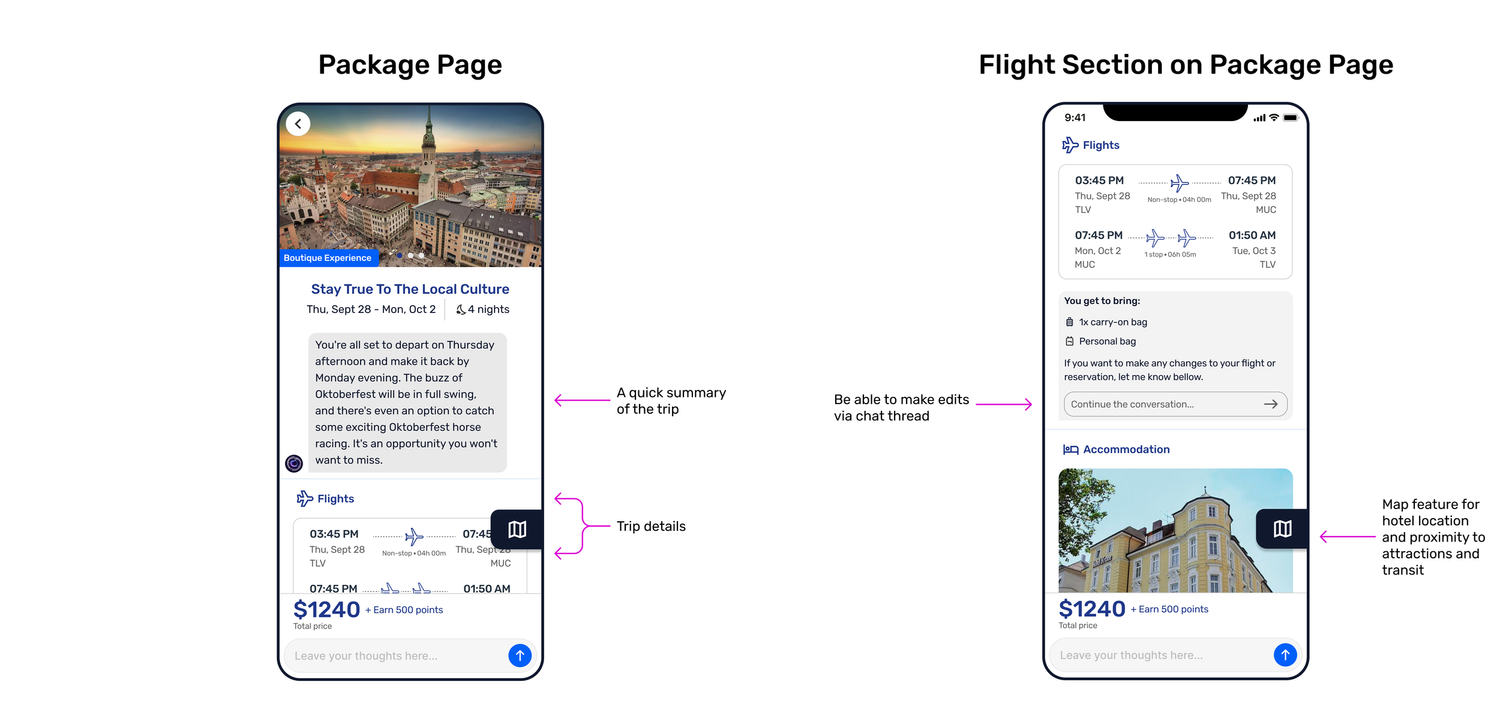
Partner interest created a deadline the roadmap couldn't meet. One engineer, real clients waiting, and a native app that would take months we didn't have. Keeping Plan A meant showing up to those conversations with the same Figma file for another two quarters, and watching the interest cool.
Sitting with the founders, we made the call together: kill the app, keep the concierge. The prototype had already done its job. Holding onto it as the shipping plan would have cost us the pilot.

Nothing humbles you quite like finishing a beautiful app and realizing nobody is available to build it. My Figma file walked so the product could run.
Plan B: rebuilding the concierge in WhatsApp
This is where the beachhead decision paid off. Because we had scoped to Israel, we had a channel almost everyone in the market already used every day. Moving Daniel into WhatsApp cut the install step out of the funnel entirely and shrank the build from months to something the team could actually ship.
- Used daily by 95%+ of Israelis
- Already trusted for personal and business communication
- Purpose-built for conversational AI
What we gave up: the rich visual surfaces, the upsell moments, and most of the brand control our partners liked in the app. What we got: zero adoption friction, and a version of Daniel we could put in front of a real pilot instead of a pitch deck. For a company that needed proof more than polish, that was the right trade.
Rebuilding for a chat thread meant redesigning three things from scratch:
Interaction architecture
Mapped the conversational logic, ensuring users could seamlessly adjust trip preferences, view curated options, and complete bookings natively within a single chat thread.
State management & edge cases
Designed how the system handles real-time disruptions, from itinerary changes to sold-out bookings or ambiguous user inputs, to keep the experience frictionless.
Daniel's voice
Defined his persona, tone, and formatting rules so a message in a crowded chat thread still felt premium and human rather than like an automated notification.
What I took from it
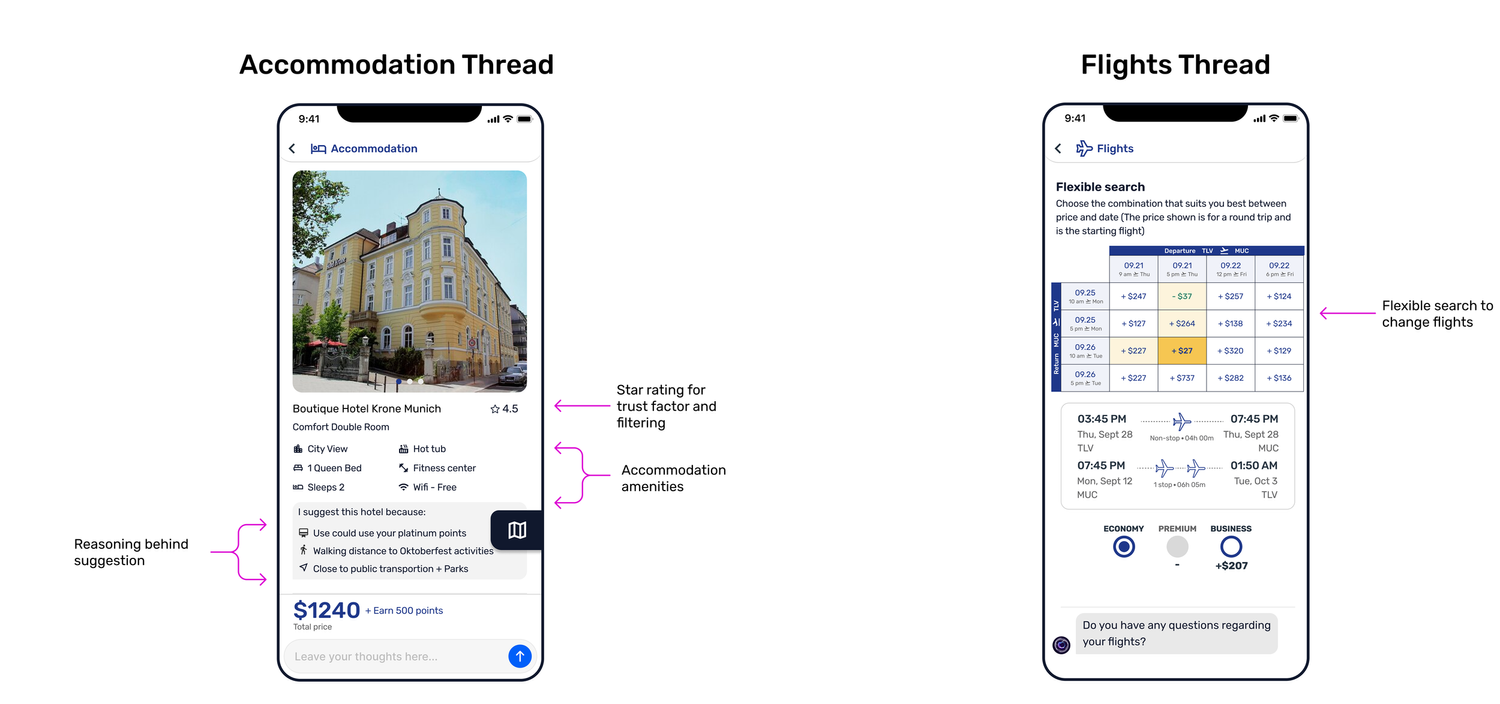
The most valuable thing I did on Via wasn't the app. It was agreeing to throw the app away.
The prototype was the best work, and it was still the right thing to cut, because its job was to win belief and it had already done that. Recognizing when an artifact has finished its job is a product decision, not a design one, and it's the one I'd point to if you asked what I actually contributed here.
What I'd do differently: I'd pressure-test delivery feasibility earlier. We designed Plan A knowing the team was one engineer, and we could have surfaced that constraint before the roadmap forced it. The pivot was right, but it could have been a plan instead of a save.